
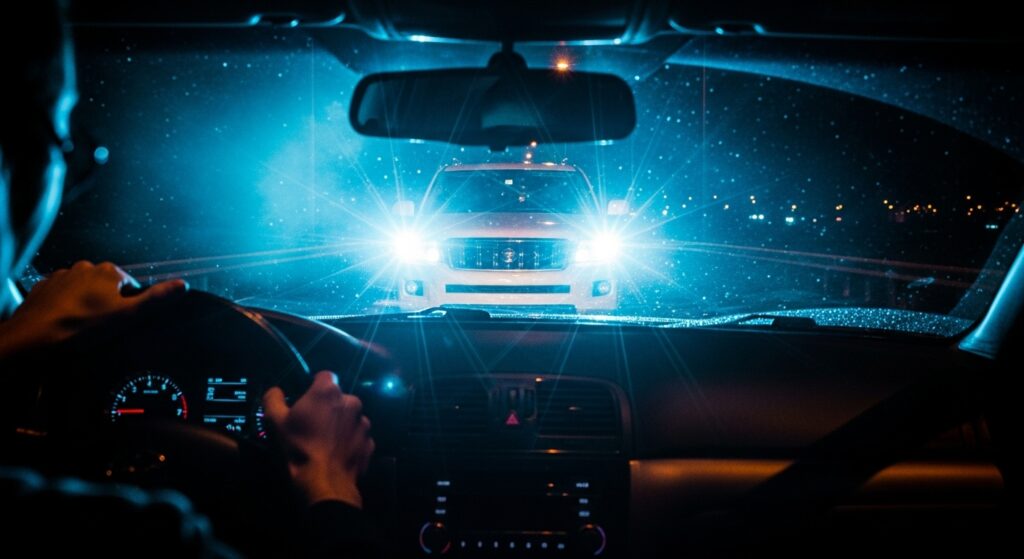
Understanding why 2026 headlights are blinding you is the first step toward reclaiming your safety and confidence on the road after dark. 🚗
If you have driven at night recently, you know the feeling of pure, white-knuckle terror when an oncoming truck or SUV crests a hill. For several seconds, your world turns into a white void. You aren’t just “sensitive to light”—you are experiencing a physiological phenomenon that has reached a breaking point in 2026. While most people blame “bright bulbs,” the reality is a perfect storm of physics, vehicle design, and a specific biological “glitch” in your eyes. 👁️
The realization that your “night blindness” might not be your fault—but rather a result of how modern light interacts with your retina—is a massive relief. However, you cannot control the cars on the road; you can only control the “shield” inside your eyes. To see how to build that internal defense, you must read my full iGenics Reviews 2026 investigation, where I break down the nutrients that help your eyes “snap back” after being blinded by glare.
The Science of 2026: Why the Glare is Quantifiably Worse
To understand why 2026 headlights are blinding you, we have to look at the transition from “Discomfort Glare” to “Disability Glare.” Discomfort is just an annoyance; Disability Glare is when the light actually prevents you from seeing objects on the road. 📉
1. The 450nm Blue Light Peak
Modern LED and Laser headlights in 2026 aren’t just “whiter”—they have a massive intensity peak in the 450-nanometer range (Blue Light). Blue light is high-energy and scatters significantly more than the yellow light of old halogen bulbs. This is known as Rayleigh Scattering. When that blue light enters your eye, it bounces off the structures inside your vitreous humor, creating a “haze” that washes out your vision entirely. 🔬
2. Pulse Width Modulation (PWM) Flicker
Many 2026 LED headlights don’t stay “on” constantly; they flicker at ultra-high speeds to save energy. While you can’t consciously see the flicker, your optic nerve and retina are forced to process these rapid-fire “micro-shocks” of light. According to research on PubMed, this constant strobing effect causes faster fatigue of the photoreceptor cells, making it harder for your eyes to adapt back to the darkness once the car has passed. 🧬
3. The Geometry of the “SUV Assault”
In 2026, over 80% of new vehicle sales are SUVs and trucks. Because their headlights are mounted higher (often at the same level as your rearview mirror or eyes), the light isn’t hitting the pavement—it’s hitting your macula directly. This creates an immediate state of Chronic Proinflammatory Environment (CPE) because the light intensity is high enough to trigger a “mini-burn” on the retinal surface. 🛡️
5 Practical Methods to Surivive the “Night Blinding” Era
If you are over 50, your eyes take up to 8 times longer to recover from a headlight flash than they did in your 20s. Here are five high-value, actionable strategies to manage this 2026 reality:
1. The “Right-Shoulder” Visual Anchor
When an oncoming car approaches, do not look at their lights or even at the center of the road. Fix your gaze on the white line on the right side of the lane (the “fog line”). This uses your peripheral vision to guide the car while protecting your central macula—the most sensitive part of your eye—from the direct “bleaching” of the LED beam. 🛣️
2. Demand “High-Index” Anti-Reflective Coatings
Not all “night driving glasses” are equal. In 2026, you should look for lenses with a residual reflection of less than 0.2%. Standard coatings still allow light to bounce inside the lens, creating double-images of far-away headlights. A high-end AR coating ensures the light passes through cleanly, reducing the “halo” effect around streetlights. 👓
3. Implement the “Deep Blink” Recovery
The moment a car passes you, perform three “deep blinks”—squeezing your eyelids shut for half a second each time. This stimulates the production of the oily layer of your tear film, which helps to smooth out the surface of the cornea and reduces the “scattering” of the next set of headlights. 💧
4. Clean the Inside of Your Windshield
Most people only clean the outside. Over time, a film of plastic outgassing (that “new car smell”) and dust builds up on the inside of the glass. When 2026 high-intensity LEDs hit that film, it creates a massive “starburst” effect that covers your entire field of view. A simple microfiber cloth and vinegar-based cleaner can reduce glare by 30%. 🧼
5. Check Your “Visual Purple” Levels
Your ability to see at night depends on a pigment called Rhodopsin. If you have been struggling more than usual, it is a sign that your body is failing to regenerate this pigment quickly enough. This is often the first sign of a nutritional gap that leads to Night Vision Issues. 🗓️
The Role of Specialized Ocular Defense
Because 2026 headlights are blinding you with such intensity, the “old school” approach of just taking Vitamin A is no longer sufficient. Your retina needs a “cooling system” to survive the phototoxicity of modern LEDs. 💊
In 2026, clinical research has identified Saffron as the ultimate “glare shield.” Saffron doesn’t just act as an antioxidant; it actually stabilizes the photoreceptor cell membranes, making them less likely to “bleach out” when hit by bright light. When paired with Bilberry, which increases the speed of Rhodopsin regeneration, you are essentially giving your eyes a “faster processor” to handle the light/dark transitions. 🔬
Specialized supplements are now a required tool for any night driver over 40. By providing the specific carotenoids (Lutein and Zeaxanthin) that build up the “Macular Pigment Optical Density,” you are creating a physical yellow filter inside your eye that naturally “mutes” the blue peak of modern headlights. 🛡️
You can learn more about the systemic connection between your lifestyle and your vision in our health and wellness category. 📑
Conclusion: Reclaiming Your Visual Independence
The fact that 2026 headlights are blinding you is a combination of bad design and biological vulnerability. While you can’t change the cars on the road, you can “waterproof” your eyes against the glare. By understanding the physics of scattering and the biology of Rhodopsin, you can move from a state of fear to a state of control. 🏁
Don’t let the “white-out” of modern LEDs force you off the road. Your freedom and your safety are non-negotiable. Feed your eyes the barrier-crossing nutrients they need to extinguish the internal fire and see the road as it was meant to be seen. 🛡️
If you want to see the exact 2026 formula designed to speed up headlight recovery and stop glare disability, make sure to read my final report here: iGenics Reviews 2026: The Driver’s Verdict 👈

Pingback: 5 Critical Signs You Need a Proven Eye Detox (The Revolutionary 2026 Guide) - Thrive Feeling